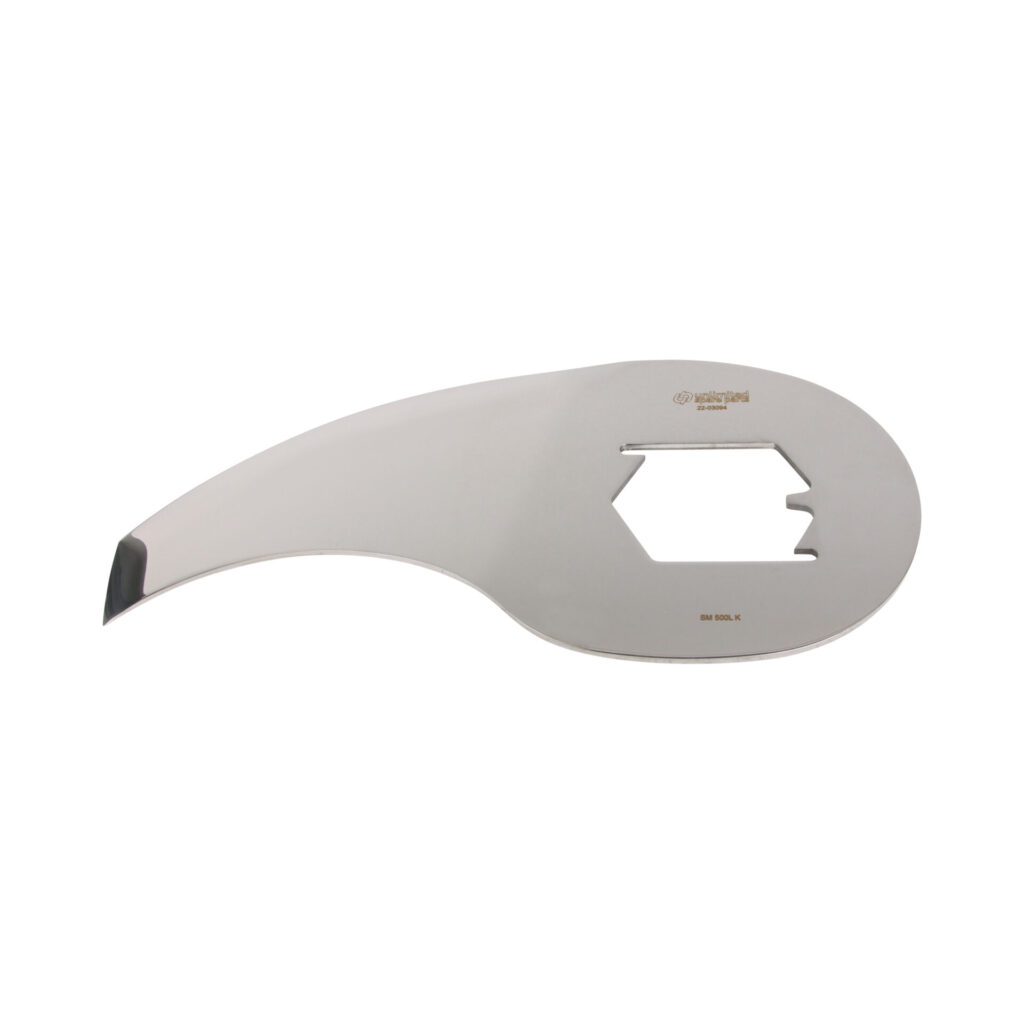
Industrial knives and blades contribute to quality and efficiency

In the food industry, every cut counts. Products are diversifying rapidly, machines are becoming more complex and reliability is crucial to keep margins healthy. Therefore, both manufacturers and OEMs need industrial knives and blades that fit their specific process, product structure and hygiene requirements.

Wensing combines a hundred years of practical experience with in-depth knowledge of food processing, processing and portioning. This way you can always count on a solution that suits your application.

Industrial knives and blades tailored to your product and process

No product is the same. Think of the fiber structure of meat or the hard texture of raw vegetables. Each segment requires a different cutting method, grinding angle, type of material or tooth geometry. Our engineers look at your production environment, line speeds and hygiene conditions, in order to ensure precisely the industrial knives and blades that minimize waste and optimize product presentations. This results in measurable improvements in quality, accuracy and process reliability for customers.

Your all-in-one partner for cutting technology

Wensing offers all services to completely unburden you. Expert advice, development of new cutting solutions, delivery from stock and professional maintenance as industrial knife sharpener. We deliver industrial knives and blades to both OEMs and manufacturers and quickly identify where optimization is possible. Whether that is to improve portioning, reduce downtime or achieve a higher cutting speed. With in-depth market knowledge, solid production and a sharp focus on quality, we help you deliver top performance.

Frequently asked questions

A standard knife is designed for general applications, while a custom knife is fully tailored to your product structure, cutting load and machine design. As a result, customization performs better at high speeds, varying product textures and specific hygiene conditions. The result is a more consistent cutting pattern, lower process costs and higher reliability of the entire production line.

For a correct delivery, the base material, the exact dimensions (diameter, thickness, heart holes), the tooth or cut geometry and the type of product you want to cut are the most important specifications. Information about line speed, load and hygiene requirements also helps to perfectly match the knife to your process. With this data, our engineers can assess which solution delivers the best cutting quality and process reliability.

The sharpening frequency depends mainly on the product (e.g. meat, fruit and vegetables or vegetarian), the line speed and the load on the blade. In practice, this means that knives must be checked regularly and sharpened periodically to ensure consistent cutting quality, food safety and minimal waste. If performance drops or wear becomes visible, grinding or replacement is necessary to prevent downtime.

Industrial knives and blades must meet food-grade material specifications, have a smooth and cleanable surface, and be designed to prevent bacterial growth and product residue. The blade must be able to withstand intensive cleaning, moisture, temperature changes and chemical agents, without affecting the cutting edge or the material structure. This keeps the production process safe, stable and in accordance with the applicable guidelines.