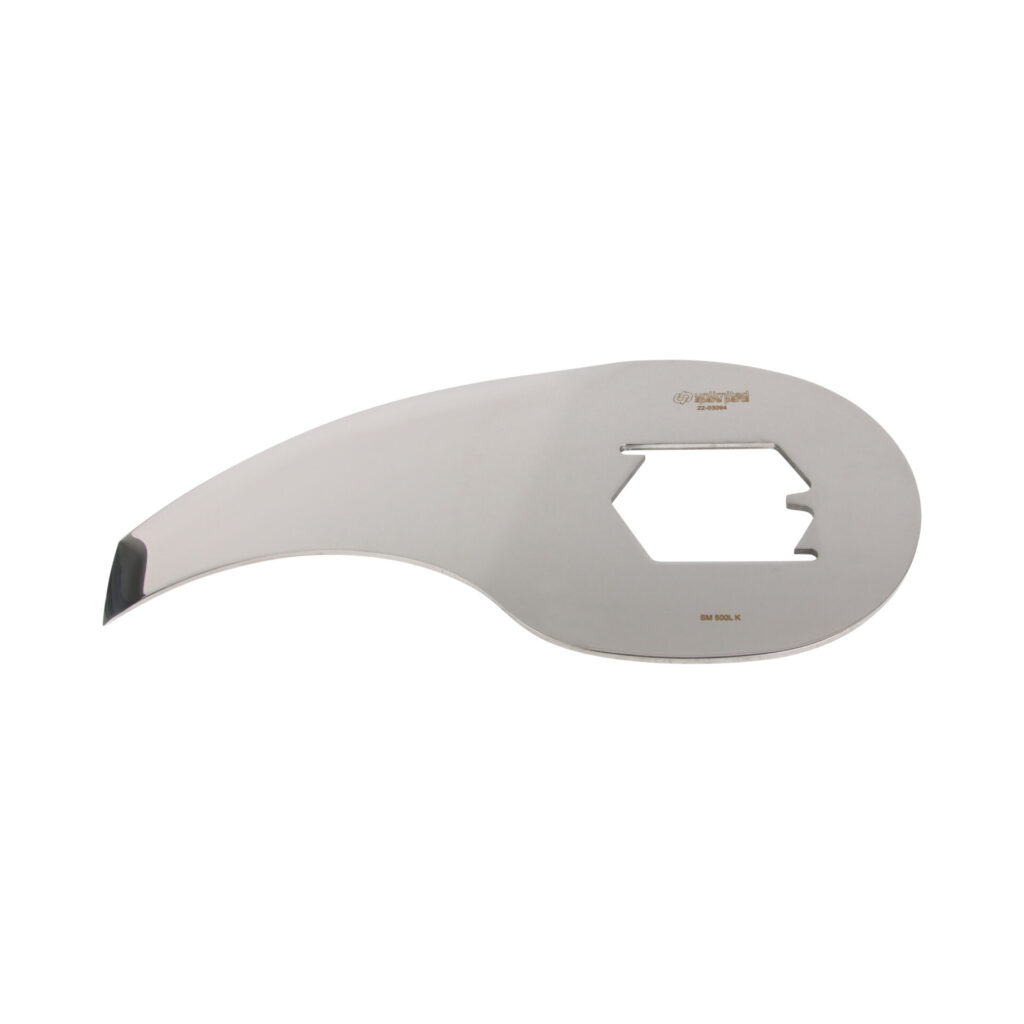
Industrial knives and blades contribute to quality and efficiency

In the food industry, every cut counts. Products are diversifying rapidly, machines are becoming more complex and reliability is crucial to keep margins healthy. Therefore, both manufacturers and OEMs need industrial knives and blades that fit their specific process, product structure and hygiene requirements.

As an industrial blade supplier, Wensing combines a hundred years of practical experience with in-depth knowledge of food refining, processing and portioning. This way you can always count on a solution that suits your application.

Industrial knives and blades tailored to your product and process

No product is the same. Think of the fiber structure of meat or the hard texture of raw vegetables. Each segment requires a different cutting method, grinding angle, type of material or tooth geometry.

Our engineers look at your production environment, line speeds and hygiene conditions, in order to ensure precisely the industrial knives and blades that minimize waste and optimize product presentations. This results in measurable improvements in quality, accuracy and process reliability for customers.

Industrial knives and blades

Industrial blade supplier

We are much more than just an industrial blade supplier. Wensing offers all services to completely unburden you. Expert advice, development of new cutting solutions, delivery from stock and professional maintenance, such as our industrial knife and blade sharpening service.

We deliver industrial knives and blades to both OEMs and manufacturers and quickly identify where optimization is possible. Whether that is to improve portioning, reduce downtime or achieve a higher cutting speed. With in-depth market knowledge, solid production and a sharp focus on quality, we help you deliver top performance.

Frequently asked questions

A standard industrial knife is designed for common machines and applications. A custom knife is useful when a standard solution does not sufficiently match the product, machine or cutting process. Material, geometry, tooth design, coating and dimensions can then be adapted to the application.

Useful information includes the machine manufacturer and model, blade dimensions, mounting details, material and any available OEM or article number. A technical drawing or existing sample can also help identify the correct specification. For custom applications, information about the product and cutting process is equally important.

Poorer cut quality, increased cutting resistance, inconsistent portions, product damage or visible edge wear can indicate that sharpening is required. Resharpening is generally possible while the required geometry and dimensions can still be restored. Severe damage, cracks, deformation or insufficient remaining material can make replacement necessary.

Knives in direct contact with food must be suitable for their intended food-contact application. The material and finish should be compatible with the product, production environment and cleaning process. Surfaces should also be designed and maintained so they can be cleaned effectively and do not unnecessarily retain product residues.

A technical drawing, existing knife and machine information can be used as a starting point for specifying a replacement or custom cutting solution. For the best result, information about the material being cut, production speed and any problems with the current knife should also be included.